

Most law firms know they need updated attorney headshots. Where things get less clear is understanding what type of photos the firm actually needs — and why the difference matters.
Attorney headshots and portrait photography are not the same thing, even if they look similar at first glance. Each format serves a different role in law firm marketing, and confusing the two can leave a firm’s visual presence looking inconsistent or underpowered.
At Law Firm Photos, we work exclusively with law firms and photograph attorneys across Los Angeles and Southern California. One question comes up consistently from managing partners and marketing teams alike:
Should our firm be using standard headshots, or professional portraits?
Here’s a straightforward breakdown of how the two compare, where each works best, and how to decide what your firm actually needs.
What Is an Attorney Headshot?

An attorney headshot is a clean, professional photograph — typically framed head and shoulders against a neutral background. The goal is simple: clearly identify the attorney in a professional way.
Attorney headshots are commonly used for:
- Attorney bio pages
- Legal directory listings (Avvo, Martindale, FindLaw)
- LinkedIn profiles
- Internal firm directories
- Bar association profiles
For solo attorneys, smaller firms, or new associates joining an established team, a well-executed headshot is often exactly what’s needed. It’s consistent, practical, and works across most professional platforms.
The issue is that many firms rely exclusively on headshots even after their marketing and branding have moved well past what a basic headshot can support.
What Is Attorney Portrait Photography?

Attorney portrait photography goes further than a standard headshot. Rather than simply identifying the attorney, the image is designed to communicate authority, credibility, and brand identity.
A strong attorney portrait often includes:
- Environmental depth — office, conference room, or architectural details
- Intentional posture and framing that reflects leadership or role
- Lighting calibrated to match the firm's visual identity
- A consistent visual style used across the entire team
When a law firm invests in portrait photography, it’s typically building a visual system, not just refreshing individual photos. Each image is designed to feel like it belongs to the same brand.
This matters because prospective clients often spend time reviewing attorney bio pages before contacting a firm. A portrait that reads as confident and cohesive communicates professionalism before a visitor reads a single word.
A Real Example: When a Law Firm's Office Doesn't Photograph Well
One concern that comes up fairly often with portrait photography is the office environment itself. This is actually one reason why law firms use specialized photography services — professionals know how to work with real office spaces and still produce polished results.
Many attorneys assume that environmental portraits require a modern, architecturally impressive space. In practice, that’s rarely necessary. Most offices — even modest ones — can work well with the right lighting and composition.
Recently, I photographed a firm that wanted environmental portraits but was concerned parts of their space looked dated. Instead of forcing a location that didn’t feel right, we walked the office together and found a simple corner that worked: a clean wall, a table, a plant.
With professional lighting and thoughtful framing, the final portraits looked polished, modern, and consistent with the firm’s brand. The environment added subtle depth without drawing attention to itself.
In situations like this, many firms choose to photograph both environmental portraits and traditional headshots in the same session. A mobile studio setup allows us to capture directory-style headshots and more dimensional portraits in a single visit — different images for different contexts, all with the same consistent look.
The Practical Difference: Where Each Works Best
The simplest way to think about it:
Headshots identify attorneys. Portraits represent them.
Where attorney headshots work best:
- Legal directory listings (Avvo, Martindale, FindLaw)
- LinkedIn profiles
- Small attorney bio thumbnails
- Internal directories and org charts
- Quick profile updates for new attorneys
Where attorney headshots work best:
- Attorney bio pages on modern law firm websites
- Leadership and practice group pages
- Homepage hero sections
- Speaking announcements and press features
- Recruitment pages showcasing firm culture
If a law firm is actively investing in its website, branding, or marketing materials, portrait photography typically holds up better — and looks more intentional — across these larger visual contexts.
Are Lawyer Portraits Different from Headshots?
Yes. Lawyer portraits and headshots serve different purposes.
A headshot is a simple cropped photo used to identify an attorney on a website bio page or professional directory.
A portrait is a more intentional photograph that incorporates lighting, posture, and environment to communicate authority and brand identity.
Portraits are typically used on firm websites, leadership pages, and marketing materials where visual consistency and professionalism are especially important.
Why Consistency Matters More Than the Individual Photo
One of the most common problems on law firm websites has nothing to do with any individual photo. It’s the lack of consistency across the team.
Browse the attorney roster at many mid-size firms and you’ll find photos taken in different years, under different lighting, and sometimes by entirely different photographers. Some look highly professional. Others look casual or a decade old.
Even if each image is technically fine on its own, the overall effect reads as disorganized. Clients notice — even if they can’t articulate why.
A structured photography system solves this by establishing consistent lighting, composition, and tone across the entire attorney team. Every image supports the same brand identity, whether it’s the managing partner or a first-year associate.
For firms with multiple offices across Los Angeles, Orange County, and San Diego, maintaining that consistency requires planning. It doesn’t happen by accident.
Why On-Site Photography Works Best for Law Firms
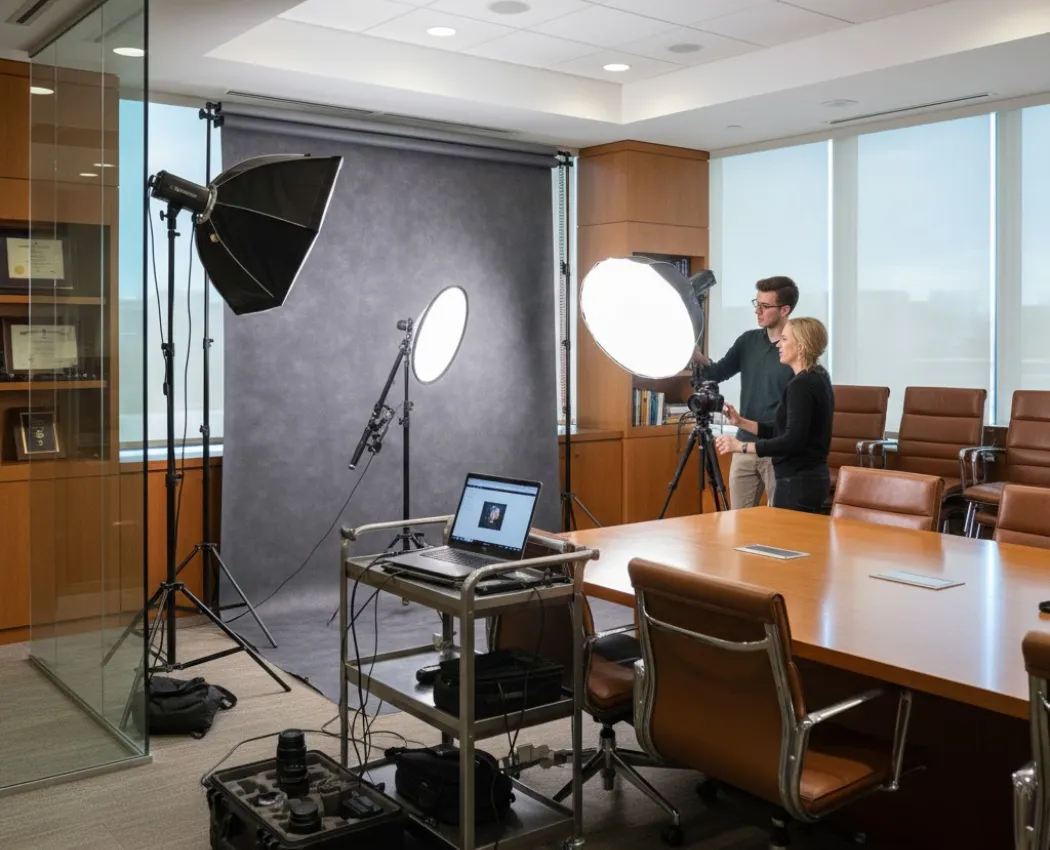
The biggest logistical challenge with law firm photography isn’t cost. It’s time.
Attorneys bill by the hour, and traveling to an outside studio can quickly become impractical. That’s why most of our sessions are conducted on-site. We bring the studio to the firm — professional lighting, backdrops, and equipment — and set up inside a conference room or available office space. Most attorneys are in and out in under fifteen minutes.
For larger firms photographing dozens of attorneys, sessions can be scheduled around court appearances, client meetings, and depositions. The disruption to billable time is minimal, and the visual results are the same as a full studio session.
Which Option Is Right for Your Firm?
It depends on what you’re trying to accomplish.
If you need a quick update for a new associate, a well-executed headshot is often all that’s required. If your firm is redesigning its website, refreshing its brand, or investing more heavily in marketing, portrait photography typically provides stronger and more versatile imagery.
Many firms ultimately benefit from both formats:
- Headshots for directories and professional listings
- Portraits for websites, leadership pages, and marketing materials
If you’re exploring options, our law firm photography services covers portrait and team photography in more detail. When you’re ready to move forward, reach out to schedule a consultation — we’ll assess what you have and recommend the most efficient approach.
Final Thoughts
Attorney headshots and portrait photography both have an important place in law firm marketing. The mistake is treating them as interchangeable when they serve different purposes.
A headshot identifies an attorney. A portrait communicates authority and brand identity.
When your firm’s photography aligns with your marketing goals, the result is a more consistent, professional presence across every platform where clients encounter you — your website, your directory listings, your LinkedIn profile, and beyond.
FAQs
What are attorney headshots?
Attorney headshots are professional photos that focus mainly on a lawyer’s face and shoulders, used on law firm websites, LinkedIn profiles, and legal directories. They are designed to present attorneys in a credible and approachable way for clients and professional audiences.
What is attorney portrait photography?
Attorney portrait photography refers to professional photos of lawyers that may include more of the body or surroundings, not just the face. These portraits are often used on law firm websites, profiles, publications, or marketing materials to present attorneys in a professional setting.
Are lawyer portraits different from standard headshots?
Yes, lawyer portraits are different from standard headshots because they often include more of the body and sometimes the office environment. Standard headshots typically focus only on the face and shoulders for professional profiles.
Why do law firms invest in professional attorney photos?
Law firms invest in professional attorney photos to present their lawyers as credible, trustworthy, and approachable. High-quality photos also create a strong first impression on websites, legal directories, and marketing materials.
How often should law firms update their attorney headshots?
Law firms should update their attorney headshots every 2–3 years or whenever there’s a noticeable change in appearance or branding. Regular updates keep the firm’s website and profiles looking current and professional.
Can professional photography improve a law firm website?
Yes, professional photography can improve a law firm website by making it look more credible, polished, and trustworthy. High-quality images also help visitors connect with the attorneys and create a stronger first impression.