

The price of a professional headshot photography varies more than most people expect. For individual attorneys, sessions typically run between $150 and $600. For law firms booking a full team, the investment usually falls between $1,000 and $5,000 — sometimes more, depending on firm size and session scope.
The wide range isn’t arbitrary. It reflects real differences in what you’re getting: the photographer’s experience, how many attorneys are being photographed, whether the session is on-location at your office, and what’s included in post-production.
This breakdown explains what drives headshot pricing, what law firms should realistically budget, and what to look for when evaluating your options.
What Does a Professional Headshot Cost?
Most pricing falls into one of two categories: individual sessions and group or firm-wide sessions.
Individual Attorney Sessions
For a single attorney, a professional headshot session typically costs between $150 and $600. Budget-range photographers tend to offer minimal editing and shorter session times. Higher-end photographers bring more controlled lighting setups, longer shoots, and more refined retouching.
If you're a solo practitioner updating your website photo, spending toward the middle or upper end of this range is usually worth it. Your headshot is on your website, your LinkedIn profile, your Google Business Profile, and every legal directory you're listed in. It's doing a lot of work.
Law Firm Team Sessions
For firms photographing multiple attorneys, per-person costs often decrease as team size grows — but total investment climbs. A firm with ten attorneys can expect to spend $2,000 to $5,000 for a professionally run on-location session with full retouching.
Larger firms — 25 attorneys or more — may invest significantly more, especially when sessions span multiple days or multiple office locations.
What Affects the Price of Headshots?
Understanding these factors makes it easier to evaluate what you’re actually paying for.
Photographer Experience and Specialization
A photographer who works exclusively with law firms charges more than a generalist — and for good reason. They understand what the legal profession expects: clean, authoritative images that hold up across every context a headshot gets used, from a firm's homepage to a federal court filing. That specific expertise is priced accordingly.
Experience also shows in efficiency. Photographing fifteen attorneys in a single day without disrupting client meetings or depositions requires planning most generalist photographers simply haven't done. On a recent shoot with a mid-sized firm, the plan was to start with group photos — but the lead attorney got pulled into an important call right as we were setting up. We pivoted immediately and started with individual headshots instead. By the time he was off the phone, we were ahead of schedule. Flexibility isn't a nice-to-have in a law office. It's the job.
On-Location vs. Studio
On-location sessions — where the photographer brings equipment to your office — cost more than studio sessions. There's travel time, setup time, and the logistical complexity of working inside an active law office. That said, most law firms prefer on-location work because it eliminates billable time lost to commuting attorneys across town.
Retouching and Post-Production
Standard packages include one professionally retouched image per attorney. Additional retouched selects can be added — firms photographing larger teams should ask about bulk pricing when booking. Basic retouching covers color correction and minor cleanup. More detailed work — background replacement, advanced skin retouching, multi-format exports — is available as an add-on.
Session Length and Complexity
A 30-minute solo session costs considerably less than a half-day shoot covering a full department. Complexity factors include number of outfit changes, group shots, office environment photos, and whether the firm also needs video.
What's Typically Included in a Headshot Package?
Most professional headshot sessions include the photography session itself, professional lighting setup, a photo selection process, basic editing or retouching, and delivery of final high-resolution files.
What varies is the depth of each component. On the editing side, some photographers include only color correction; others offer full skin retouching, background replacement, and format optimization for every platform the image will appear on. It’s worth asking what’s included before booking — particularly for firm-wide sessions where post-production volume adds up.
What's the difference between a headshot and a portrait?
The difference comes down to purpose. Headshots are typically more structured and consistent, designed for professional use like firm websites, directories, and LinkedIn profiles. Portrait photography, on the other hand, allows for more flexibility in style, setting, and personality. If you’re trying to decide which is right for your firm, this guide on attorney headshots vs portrait photography breaks down how the two differ—and when each one makes sense for law firm marketing.
How Often Should Attorneys Update Their Headshots?
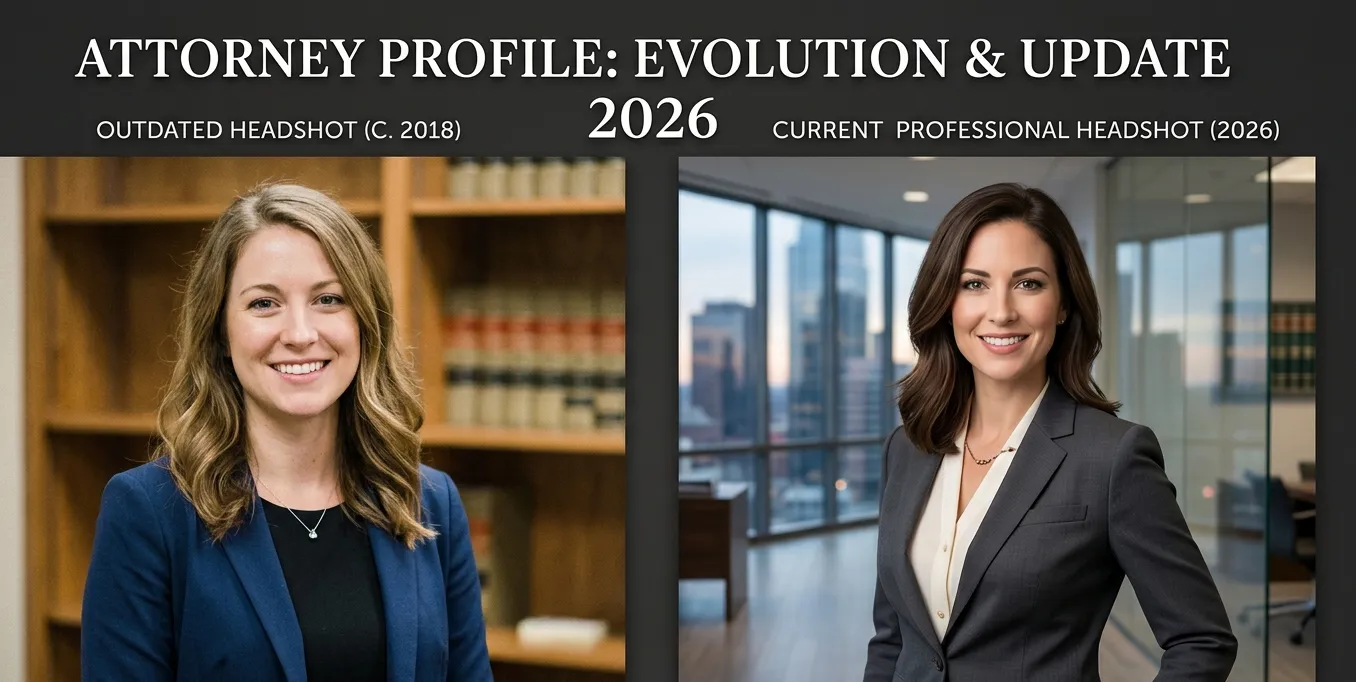
How Often Should Attorneys Update Their Headshots?
Most attorneys should update their headshots every 2 to 3 years. Sooner if there’s been a significant change in appearance, a move to a new firm, or a rebrand of existing materials.
Outdated headshots create an immediate credibility problem. A client who has seen your seven-year-old photo and meets you in person for the first time is already doing the math. Beyond the obvious, it signals to prospective clients that the firm doesn’t stay current — which is the last impression a law firm wants to make.
None of us are in a hurry to let go of that slightly younger, slightly more luminous version of ourselves — that’s just human. But in business, your photo needs to match the person walking into the room. The good news: my retouching is excellent, and I’m more than happy to take a couple of years off in post.
Are Professional Headshots Worth the Investment?

For most attorneys, yes — particularly when you consider how many places a headshot appears. Your firm’s website, LinkedIn, Martindale-Hubbell, Avvo, Google Business Profile, conference speaker bios, press releases. A single session produces images that work across all of them.
The more important question is whether the headshot you have is working for you or against you. A low-quality photo on a high-quality firm website sends a mixed message. Clients notice the gap, even if they don’t articulate it.
Law firm marketing directors often find that updated photography is one of the higher-ROI investments in their budget — not because photography is magic, but because it’s frequently neglected while everything else gets attention.
What Should Attorneys Wear for Their Headshots?
Clothing choices matter more than most attorneys expect. A few practical guidelines:
- Structured, well-fitted clothing reads as professional on camera. Classic suits, blazers, collared shirts, and blouses work consistently.
- Solid, mid-tone colors photograph best: navy, charcoal, burgundy, forest green. Bright whites and stark blacks can throw off exposure.
- Avoid busy patterns, large logos, and anything that wrinkles easily. Wrinkled fabric is noticeable at the sizes headshots appear online.
- When in doubt, dress one level above your average workday attire.
A good photographer will give you specific guidance during pre-shoot consultation. If they don’t, that’s worth noting.
One situation worth planning for specifically: new hire photography. If you’re adding attorneys to an existing team, their headshots need to match what’s already on your website — same background, same lighting style, same general aesthetic. Sending a new associate to a different photographer, or letting them submit their own photo, is how firm websites end up looking inconsistent.
I photograph new hires regularly and have developed a precise process for matching existing lighting setups and backgrounds. When a new attorney joins your firm, the goal is for their headshot to look like it was always part of the team — not like it was taken somewhere else on a different day.
If you’re starting fresh and building out your firm’s visual style from scratch, we’ll work through clothing choices with you before the shoot. It’s part of the process, not an afterthought.
How to Evaluate a Law Firm Headshot Photographer
Looking at a photographer’s portfolio answers most of the important questions before you have a single conversation.
- Does the lighting look controlled and consistent across subjects?
- Do the attorneys look natural and confident, or stiff?
- Is the editing clean — or over-processed?
- Are the images consistent across the team, or does every photo look like it was taken by a different person on a different day?
That last point matters especially for firms. Consistency across your team’s headshots signals organizational cohesion. When every attorney page looks like it came from the same session — same lighting, same tone, same quality — the firm looks like it has its act together. Which, presumably, it does.
Why Law Firm Photography Is Different
Law firm photography isn’t just about showing up with good equipment. It’s about understanding the operational constraints of a professional services environment — and working around them without causing disruption.
That means scheduling around depositions and court appearances, moving efficiently through a firm so no attorney is waiting longer than necessary, maintaining confidentiality around anything visible in the office, and delivering images that look consistent whether you photographed the managing partner at 9 a.m. or a third-year associate at 4:30 p.m.
At Law Firm Photos, we work exclusively with law firms across Los Angeles, Orange County, and San Diego. It’s a narrow focus, but that’s the point. We know the environment, the expectations, and what these images need to accomplish across a firm’s website, directories, and marketing materials.
If you’re evaluating options for your firm’s next photoshoot, our [attorney headshots page] and [law firm photography services page] are good places to start. Or reach out directly — we’re happy to talk through what a session would look like for your firm’s specific situation.
FAQ
How much do professional headshots cost for attorneys?
Individual attorney headshot sessions typically cost between $150 and $600. Law firm team sessions — where a photographer comes on-location to photograph multiple attorneys — generally range from $1,000 to $5,000 or more, depending on team size and what’s included in post-production.
How often should attorneys update their headshots?
Every two to three years is a reasonable baseline. Sooner if there has been a notable change in appearance, a move to a new firm, or a rebrand of the firm’s marketing materials.
What is included in a professional headshot package?
Most packages include the photography session, professional lighting setup, a selection of final images, basic retouching or editing, and delivery of high-resolution files for web and print. Premium packages often add deeper retouching, background replacement options, and multiple format exports.
What is the difference between a headshot and a portrait?
A headshot focuses on the face and shoulders and is designed for professional use: websites, directories, and marketing materials. A portrait is broader in scope and may include more of the body, background, or environmental context. For law firm use, headshots are the standard.
Should attorneys wear suits for headshots?
For most attorneys, yes — or at minimum a blazer and collared shirt. Structured, well-fitted clothing reads as professional on camera. Solid mid-tone colors like navy and charcoal photograph best. Your photographer should provide specific guidance during pre-shoot consultation.