

Before a potential client reads your bio, they’ve already formed an opinion. They saw your photo first. That split-second impression — professional, approachable, credible, or dated — shapes everything that follows.
Yet many law firms still treat photography as an afterthought. Strong law firm photography is one of the easiest ways to improve how a firm is perceived online.
The result, when it’s neglected, is a website that looks nearly identical to the firm two floors up.
This article covers how law firms can use attorney photos strategically across their marketing — website, directories, social media, and announcements — and why visual consistency matters more than most firms realize.
Why Attorney Photos Do More Work Than You Think
Clients search for you before they call. They visit your website, check your LinkedIn profile, scan your Avvo listing, and look you up on Google. At every stop, your photo is doing the talking.
Strong attorney headshots communicate things your bio can’t:
- That your firm takes its presentation seriously
- That your team is current, organized, and cohesive
- That you’re worth a phone call
A stale photo from 2016, or worse — different lighting and backgrounds across your team’s bios — sends the opposite message.
Clients notice. They may not say anything, but they notice.
Where Law Firms Use Photography (and Where It Often Falls Short)
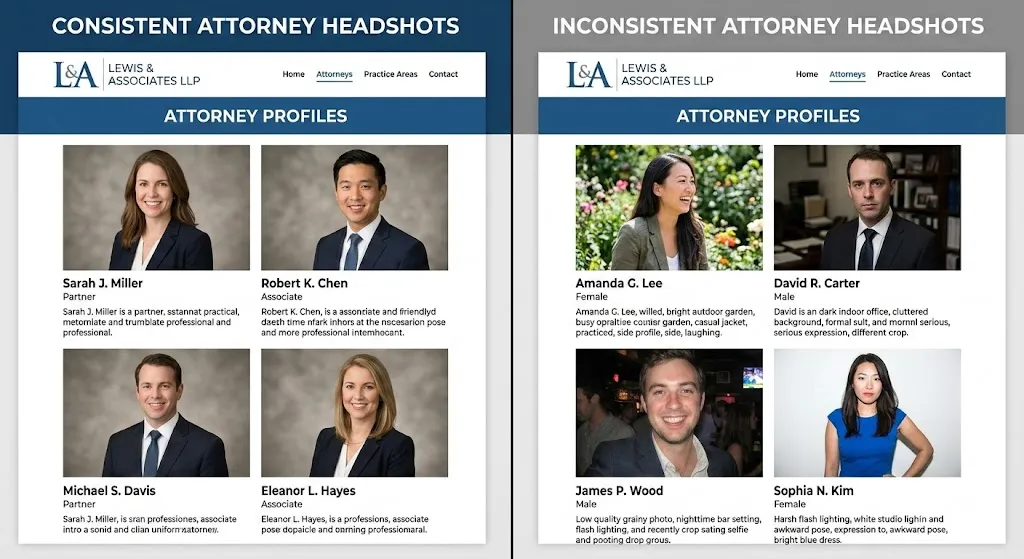
Your Website
This is the most important channel — and the one most firms underinvest in visually.
Attorney photos appear on:
- bio pages
- practice area pages
- landing pages
- leadership sections
When those photos are inconsistent — different backgrounds, crop ratios, or lighting — the whole site feels patched together.
Photos integrated thoughtfully into the design make the site feel intentional. Visitors stay longer. Inquiry rates improve.
Where Should Attorney Photos Appear on a Law Firm Website?
Many firms limit photography to bio pages, but professional law firm photography can support multiple parts of a website.
Common placements include:
- attorney bio pages
- practice area pages
- homepage leadership sections
- press and announcement pages
- recruiting and careers pages
When photography appears consistently across the entire website, the firm feels more cohesive and intentional. Visitors don’t just see individual lawyers — they see a team.
LinkedIn functions as a public resume used by referral sources, journalists, and lateral recruits.
A good LinkedIn headshot is:
- current (updated every three to four years)
- professionally lit
- cropped cleanly
- aligned with the style used on your firm’s website
Vacation photos or cropped group shots tend to undermine credibility faster than most attorneys expect.
Google Business Profile
Many clients discover firms through Google before they ever visit the firm’s website.
Your Google Business Profile pulls images directly into local search results. Those photos influence whether someone clicks your listing.
A strong profile typically includes:
- individual attorney headshots
- a team photo
- office environment photography
Missing or inconsistent images weaken local search credibility.
Legal Directories
Martindale, Avvo, FindLaw, and similar directories place attorney profiles side-by-side.
When potential clients compare multiple attorneys on the same platform, your photo becomes one of the few visual differentiators.
Journalists and researchers also use these directories. If the photo there doesn’t match the one on your website, it creates a small but noticeable doubt.
Stock Photos vs. Real Attorney Photos

Some firms still rely on stock photography — images of people who don’t actually work at the firm.
Clients usually notice this more than firms expect. When they meet you and realize the website photos don’t reflect the real team, it subtly erodes trust.
Stock photos create another problem: every firm using the same library ends up looking identical.
Original law firm photography solves both issues. Real attorneys, real offices, real personalities.
Why Visual Consistency Matters Across Channels
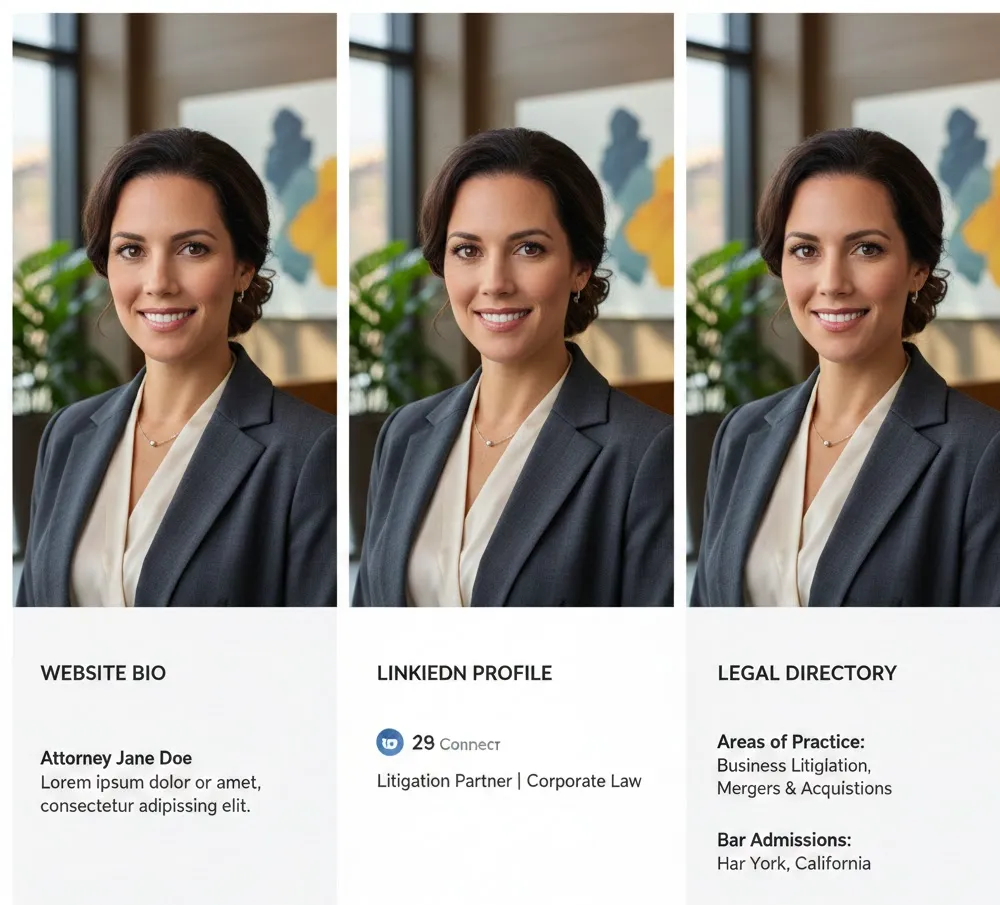
Consistency isn’t just about aesthetics. It’s about recognition.
When attorneys appear with similar lighting, backgrounds, and crop styles across every platform, clients begin associating that visual style with the firm.
A cohesive photography system often includes:
- consistent lighting setup
- standardized backgrounds
- matching crop ratios
- wardrobe guidance for the team
Done well, each attorney still looks like themselves. The firm simply looks more organized.
Not Every Attorney Should Look the Same
Consistency doesn’t mean uniformity.
A litigator and an estate planning attorney serve different clients with different expectations. Their portraits should reflect that.
For example:
- litigators often benefit from a more direct posture
- advisory attorneys often photograph well with softer expressions
- family law attorneys frequently benefit from a warmer, approachable tone
- corporate counsel often suit minimalist settings
These aren’t rigid rules, but thoughtful photography can reinforce what an attorney does — not just what they look like.
Using Photos to Support Firm Announcements
Quick Answer: What photos work best for law firm announcements?
The strongest announcements combine a polished headshot with contextual imagery.
For example:
- a partner promotion paired with a leadership portrait
- a new office announcement paired with an office environment image
- a new practice group paired with a team photo
This approach gives media outlets and social platforms more visual material to share.
Common announcement types that benefit from photography:
- partner promotions
- new associate hires
- office openings
- practice group launches
- industry awards or recognitions

Why Specialized Law Firm Photography Makes a Difference
Photographing a law firm is different from a typical corporate session. For firms looking for a guide to law firm photos, the process involves more than simply taking professional headshots — it requires understanding how legal teams work and how their time is structured.
Schedules are unpredictable — depositions run long, court dates shift, and partners sometimes have exactly nine minutes before the next client call.
After years of working inside active law offices, those logistics become familiar. Coordinating 15 attorneys across a morning, adjusting for a partner’s court schedule, or fitting a team photo between meetings becomes part of the workflow.
The photography itself is rarely the difficult part.
Managing the day is.
That operational experience matters because it protects billable time — which, in a law firm, is the resource everyone is trying to protect.
Conclusion
Photography isn’t decoration. For a law firm, it’s part of the pitch.
The firms that understand this treat their visual identity as an asset. They update their photos regularly, keep them consistent across platforms, and think about how each image supports their brand.
If your current photography doesn’t reflect how strong your firm actually is, it’s a fixable problem.
Schedule a consultation with Law Firm Photos to discuss what a photography session could look like for your team — timeline, logistics, and final deliverables.
Frequently Asked Questions
Why are professional attorney photos important for law firm marketing?
Professional photos create immediate credibility. When potential clients compare firms online, a polished headshot signals professionalism and organization.
How often should law firms update their attorney headshots?
Every three to five years is typical. Photos should also be updated after noticeable appearance changes or firm rebranding.
Should attorney photos be different across platforms?
The core image should remain the same. Only the crop or formatting should change for platforms like LinkedIn, Google, or legal directories.
Can consistent photography increase client inquiries?
Yes. Firms with cohesive visual branding typically see stronger engagement on attorney bio pages and better conversion on contact forms.
Do local elements in law firm photography matter?
They can. Office settings, skyline views, or recognizable regional details help reinforce local presence and familiarity.